

Hello and welcome to Emerge Education. We’re so excited for you to take part in our program. This page should act as a guide to everything you need to start your program. Scroll on for FAQs on getting started, information about our tech and more.
Happy learning!
There are no “teachers”, all instruction comes from the Learning Management System (LMS). But don’t worry, it’s not all on you – your Student Success Advisor will be here every step of the way.
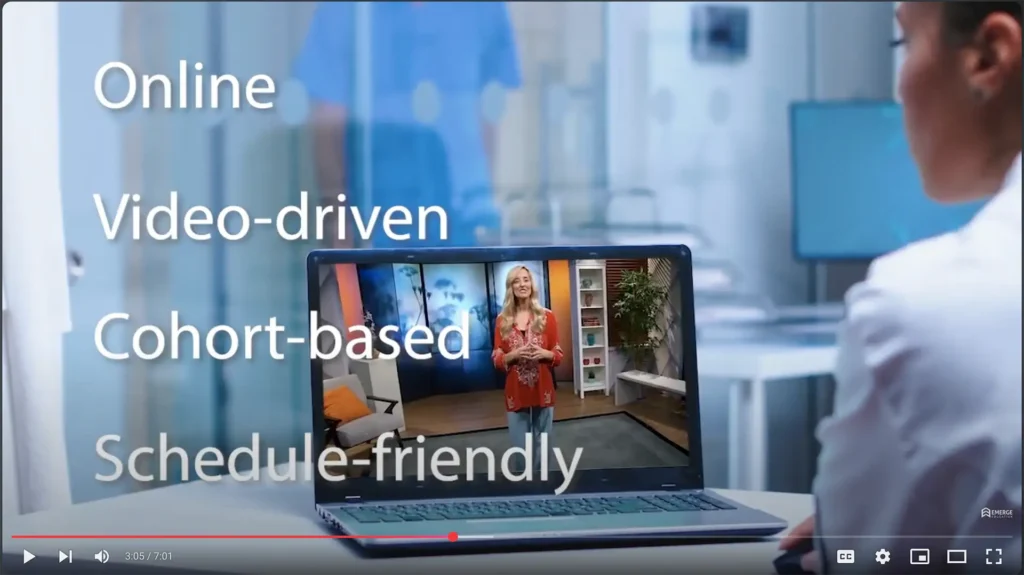
There isn’t a class schedule, you take courses when it fits into your life and can work ahead as much as you’d like. The LMS has reminders in place to keep you aware of upcoming tasks and due dates. We recommend 15 to 20 hours of coursework a week to stay on track with your program completion date.
These are preloaded, so it may say one is already due the first time you log in. Don’t worry, that doesn’t mean you’re behind. You can take quizzes as many times as you need. A score of 80+ is required before moving on.
Emerge Education expects you to finish all the courses in your program by the date provided by your Student Success Coach through email. However, you will continue to have access to your LMS after your program end date, this way you can revisit course lessons and re-watch videos as you prepare for your National Certification Exam.
Emerge Education serves students across the nation, in accordance with the laws and regulations in place for each state. The following grievance procedure is applicable to all students unless the student is located in a state with unique grievance policy requirements. Please refer to the Appendices to confirm whether a state-specific policy is applicable to you.
If a student has a question or problem, please contact Emerge Education your Training Specialist. It is the policy of Emerge Education to resolve student concerns in a swift and equitable manner. Students have the right to submit a complaint or grievance to Emerge Education through any means of their choosing. If by email, submit to Recruitment Email: info@emergeedu.com.
Mailed communication should be mailed to their Training Specialist at the location below:
Emerge Education
4550 Lena Drive
Mechanicsburg, PA
Since Emerge Education does not cover the cost of exam re-takes, we effectively do not “sponsor” the second attempt. Due to this fact, Emerge Education does not automatically receive exam results for non-sponsored exams. In these cases, it is the student’s responsibility to report a PASS or FAIL exam result to Emerge Education.
Emerge Education Official Student Documents
A Signed and stamped copy of your transcript, education verification letter, or award of program completion (certificate) can be sent by Emerge Education directly to you, an institution or an employer designated on your request. The following fees apply to official student document orders:
Cost for digital processing: $3.25
Cost for print and mailed services
USPS Domestic: $2.50 shipping/handling (+ $3.25 request fee) = $5.75
USPS International: $5.25 shipping/handling (+ $3.25 request fee) = $8.50
Cost for expedited services
FedEx (Overnight Domestic): $30 shipping/handling (+ $3.25 request fee) = $33.25
FedEx (International Priority): $55 shipping/handling (+ $3.25 request fee) = $58.25
A transcript and other documents may not be considered official if they are not sent directly by Emerge Education to the designated recipient. Contact Emerge Education for more information.
Unofficial Program Progress Report: An unofficial program progress report, that is not signed or stamped, can be printed by a student from their Emerge Education Learning Portal.
Permanent academic records, which include transcripts, are maintained by Emerge Education for students. Individual records will be maintained for a minimum of six (6) years following the end of the last Enrollment Period, graduation, or withdrawal. It is the policy of Emerge Education to not release educational or financial information to anyone other than the student. To release information to anyone other than the student, Emerge Education must have written consent from the student to do so. The student must complete the Student Information Release Form.
Exclusions:
School officials with legitimate educational interests;
Other schools to which a student is transferring;
Specified officials for audit or evaluation purposes;
Appropriate parties in connection with financial aid to a student;
Organizations conducting certain studies for or on behalf of the school;
Accrediting organizations;
To comply with a judicial order or lawfully issued subpoena;
Appropriate officials in cases of health and safety Emerge Education; and
State and local authorities, within a juvenile justice system, pursuant to specific state law.
Students who need to replace any lost/stolen/damaged or misplaced study materials should call or email their Training Specialist for assistance. There will be a replacement fee for each item. On occasion, Emerge Education may have a “used” book that can be purchased at a discounted rate.
Good attendance and academic performance are crucial for a successful learning experience. As each class includes material, labs, and other exercises that build upon each other throughout the duration of each course and program, it is important that students complete all classes and lab sessions for which they are enrolled. All Emerge Education programs are self-paced. However, each course and program has an assigned duration which has been built into a master “Learning Plan” for each student. Each Learning Plan has a respective “Course Schedule” containing a blueprint for completing each course and program within the recommended duration of the program. While self-paced, each program requires that the student devote 15-20 hours/week to their training. Doing so will ensure successful program completion within the assigned duration of the program.
The acceptance of transfer academic credits to another institution is determined by the receiving institution. Institutions individually establish criteria for transfer credit acceptance based on many factors, including but not limited to course content, degree or non-degree course, final grade, credits (if any) per course, type of accreditation, age of credits, etc.
Courses in Emerge Education’s certificate programs may or may not transfer to other institutions and depend solely on the receiving institution’s criteria and determination. Emerge Education does not imply or guarantee the transferability of credits from its certificate programs. Emerge Education has not entered into an articulation or transfer agreement with any college or university.
Due to the unique nature of Emerge Education training programs and the fact that Emerge Education instructors/staff must verify that the school’s standards have been met, students are not permitted to transfer credit in for any of the instruction. Students in all programs must meet the requirements assigned to the program, with no variance between individual learners. Additionally, Emerge Education training programs and courses are measured in Clock Hours, not Credit Hours.
After sixty (60) days of inactivity combined with a lack of communication, the student may be placed on Academic Probation. During the 60 days preceding probation, repeated efforts will have to be made to contact the student in order to offer/deliver assistance and to encourage the student to get back on track with their studies (pace of program). After 30 Days of Academic Probation, Emerge Education will review the student’s record and make a recommendation to extend the Probation period or dismiss the student from his/her program. This decision is made by the advisor. Any student who is placed on Probation remains eligible for program continuation and ultimate completion unless formally dismissed from the program. To exit probationary status, the student must simply contact Emerge Education to request that a consultation take place. At that time, the student must decide whether they wish to Withdraw (with or without a refund, depending on progress) or work to regain good standing within his/her training program.
Dismissal refers to the termination of a student’s active enrollment with Emerge Education, resulting in a student’s removal from their Emerge Education program. Being dismissed from a program does not absolve a student from any financial agreements made with Emerge Education. If a student has a contract with a sponsor or other funding source, the student may need to check in with that source to learn how being dismissed may impact that agreement. Reasons for dismissal include, but are not limited to, the following:
Additional externship/clinical site causes for dismissal (if applicable):
Students who have been dismissed from Emerge Education are not eligible for reinstatement or readmission unless a submitted appeal is approved after review and consideration.
Cheating can be defined as any inappropriate collaborative activity in which the work submitted to the school does not represent the work of the enrolled student. This would include submission of someone else’s work, submission of answers obtained through inappropriate measures, or providing answers to another student. If cheating is suspected, the student will be notified and required to respond in writing to the charges made. The response will go to an academic review for a decision on the student’s enrollment. Disciplinary action can be applied up to and including termination of the student’s enrollment. Any inappropriate behavior on the part of a student will result in an invalid submission, which must be repeated.
Student Code of Conduct
All Emerge Education students are expected to adhere to the standards and policies established by Emerge Education. Failure to adhere to the Student Code of Conduct will be subject to disciplinary action up to and including dismissal or expulsion from Emerge Education.
Students are expected to:
Additional externship/clinical site expectations (if applicable):
Academic Misconduct, Academic Integrity, and Professional Behavior
Academic integrity is expected of all students. Some programs may have additional student responsibilities associated with them based on additional standards and/or professional standards, as well as compliance with federal and state laws. Emerge Education views any act of academic dishonesty or unprofessional behavior as a serious offense that may require disciplinary measures, up to and including dismissal or expulsion from Emerge Education. Violations of academic integrity and professional behavior include, but are not limited to, the following acts:
Personal misconduct involving computers/technology
Unauthorized use of computers and technology. Theft of abuse of computer(s) and resources including, but not limited to:
During the enrollment process, all students are provided with a unique username and password, which allows them to log into the Emerge Education Learning Portal to access online training and to complete assignments, quizzes, and final exams. Each username and password combination is unique to every individual student, and Emerge Education’s Code of Conduct policy prohibits students from sharing this information. Student identity is verified by confirming the student’s first and last name, address, and telephone number prior to releasing any information. Students are responsible for all comments, exams, and assignments posted on their accounts. If a student feels that his or her account was compromised by someone else, he or she must change his or her password immediately and notify the school. Emerge Education will use the e-mail listed on a student’s account to send academic and school updates. These communications can be personal in nature, and for this reason, we recommend that students use an e-mail that is not shared with others.
If Emerge Education suspects that a student’s account has been compromised, access to the student account may be blocked until the student’s identity has been verified. This process is done only to protect the student’s interest. Students are responsible for all comments, quizzes, exams, and assignments posted on their accounts. If a student feels that his or her account was compromised by someone else, he or she must change his or her password immediately and notify the school.
All certification exams (not administered by Emerge Education) require that the student’s identity be confirmed by a proctor, by review and verification of a government-issued identification.
A student may be admitted into a Emerge Education Certification Program upon satisfying all of the following requirements:
Emerge Education does not perform criminal background checks for these programs, nor do we test students for illicit drug use. Please be advised that while Emerge Education does not perform these checks, the student’s drug, criminal, or immunization status may prevent future employment as a healthcare or IT professional. Externship sites, employers, and State Boards of Pharmacy or other regulatory boards have regulations about drug use and criminal backgrounds. Regulatory boards, externship sites, employers, and other organizations may require these screenings for placement, and adverse results may prohibit you from moving forward in the program.
Example: Because the RX-3000 program requires that the student complete an externship, a failed drug test administered by the externship site (such as Walgreens) may prevent the student from completing the Emerge Education program requirements resulting in disqualification from the Rx-3000 program.
The student understands that Emerge Education does not hold any control over the drug, immunization, criminal, or background screening processes or policies held by any organization outside of Emerge Education.
Emerge Education is committed to providing a learning environment that is free of discrimination. Equal opportunity will be extended to all persons in all aspects of our program. Emerge Education will not discriminate against a student because of race, color, religion, sex, sexual orientation, pregnancy, national origin, ancestry, age, marital status, physical or mental disability, or medical condition. If a student believes he/she is being discriminated against, he/she should report the facts of the incident to Emerge Education in writing (see Grievance and Appeal Procedures).
Emerge Education adheres to all federal laws prohibiting job discrimination based on race, color, sex, national origin, religion, age, equal pay, disability or genetic information. Review EEO requirements here.
Because Emerge Education sponsors students for all healthcare certification exams, we are notified of all student exam results as soon as they become available. In certain instances, exam results may not be made immediately available to Emerge Education – in which case we require that the student notify your Training Specialist of exam results directly. CompTIA exam results are not released to anyone except the student who has attempted the exam.
Since Emerge Education does not cover the cost of exam re-takes, we effectively do not “sponsor” the second attempt. Due to this fact, Emerge Education does not automatically receive exam results for non-sponsored exams. In these cases, it is the student’s responsibility to report a PASS or FAIL exam result to Emerge Education.
Except as noted above (see National Certification Exam Payment and Registration), Emerge Education does not offer complimentary retakes for any exams. Students will be responsible for all charges associated with scheduling and sitting for a retake examination. Students may purchase exam vouchers by contacting your Training Specialist. Payment must be received in full by Emerge Education before a voucher number will be issued to the student.
Exam preparation tools are available to assist students in preparing for his/her certification exam. Emerge Education provides students with an assortment of these tools at no additional charge. Practice exams, online assessments, and other preparation tools are available from a variety of online providers, which can be purchased by the student. While recommended, these tools are not required for students to purchase.
To be registered for National Certification exams, students must have successfully completed 100% of the program content, including all Chapter Review Quizzes (80% min score), and Course Final Exams (80% min score) as well as any additional course-related assignments. While the cost of exams is covered by Emerge Education, as a Sponsor, we reserve the right to determine exam readiness. Fees for exam registration will be paid by Emerge Education only within the Enrollment period or formally approved three (3) month extension.
Within the eligible exam registration period, Emerge Education will make every effort to ensure that students are provided with appropriate supplemental materials or resources, as deemed necessary, to meet the requirements related to the CURRENT exam objectives relevant to the student’s eligible exam(s). Due to the ever-changing nature of curriculum and exam objectives, this policy is necessary to ensure that Emerge Education only sponsors students’ exam registration in a situation where the program completion is aligned with current exam objectives.
The cost for the first attempt of each eligible National Certification exam within a student’s program is covered by Emerge Education. Emerge Education is a recognized INSTITUTIONAL SPONSOR of all certificate exams for which we prepare students. Emerge Education’s sponsorship of your exam demonstrates to the Certifying body that you have completed your education through a recognized training provider. Students who have registered for an exam under the sponsorship of Emerge Education will not be charged for the certification exam. Students are provided details of which exams he/she will be eligible to attempt prior to their enrollment in the program. In many cases, students will be eligible for MORE THAN ONE exam. Harrisburg University will cover the cost of the first attempt on each eligible exam only. The cost for any exam re-take will be the responsibility of the student. If a student fails his/her first exam attempt, he/she may use the value of their voucher for a secondary exam to cover the cost of the retake. PLEASE NOTE: In this case, he/she then forfeits the voucher for the secondary exam and any future registration cost will be the responsibility of the student.
Upon completion of his/her program, the student is required to complete an End of Program Survey. The survey includes questions on student engagement, student readiness, instructor and academic support, technology, curriculum, resources, and other support. Student feedback through the survey is an opportunity for students to have a voice in their program of study and is an essential part of our process of continual improvement.
Students who have met their program requirements, and have paid their tuition in full are eligible for receipt of a Certificate of Completion from Emerge Education, which awards the student with eligibility to Emerge Education-sponsored certification exams. Upon completion, students can immediately download their Certificate of Completion in the program wrap-up section in the LMS.
A final PASS/NON-PASS grade will be assigned based on the composite results of all modules within the student’s program. A PASS grade will be assigned upon verification that all required components of the program have successfully been completed. A Non-Pass grade is not officially recognized/reported or assigned until the student’s access to his/her training has reached the maximum 12-month expiration.
In order to achieve a PASS grade for the program, students must meet the following requirements:
*Some specialty courses/programs require that the student submit additional assignments, video simulations, or other assessed work.
Occasionally, a student may begin a certification program and then determine that the related career field is not ideal for him/her. Rather than Drop/Withdraw from the course, students have a ONE TIME option to Transfer to another course within the Harrisburg University catalog of equal or lesser tuition value. Requests for program transfer must be received by Emerge Education PRIOR TO the student’s official Program End Date, without exception. Students who have completed greater than 50% of his/her original program will NOT be eligible for a transfer.
The majority of Emerge Education programs are comprised of multiple courses, and each course will contain predecessor requirements that must be achieved/completed prior to advancing to the next course. Due to this fact, it is imperative that students understand that they must follow the outline of courses as defined by Emerge Education. In order to do so, a minimum passing score must be achieved within each of the modules/chapters of a single course before the next course will be accessible.
Quiz and Exam grades are available immediately after completion of the quiz/exam. Quizzes and Exams are considered PASS/FAIL, with a minimum passing score of 80% for all Quizzes and 80% for all Final Exams. Each may be re-taken until a satisfactory score is achieved. This is to ensure that the student is more easily able to identify difficult/challenging areas where improvement may be needed, re-focus efforts on these areas, and then re-assess for mastery of content. Some programs have graded components/assignments that are manually reviewed. Please allow up to 72 hours for such assignments to be graded and for the grade to be posted on the student’s record.
Access to Online Video Content via the Learning Portal is granted for a period of TWELVE (12) MONTHS from the Official Program Start Date (defined as ENROLLMENT PERIOD) of the student’s program, regardless of the assigned duration of the enrolled program. Additionally, all students are eligible for support for a period of 12 Months from the Start Date (Enrollment Period) of the student’s program. The availability of extended time beyond the scheduled End Date is provided in the event a student has been provided an approved program extension, as well as to allow all students ample time for course review complimented by Emerge Education Exam Preparation support during the time preceding National Certification Exams. If the student completes his/her program within the 12 Month Enrollment Period and needs additional time to prepare for National Certification Exams, he or she MAY FORMALLY REQUEST A ONE-TIME THREE (3) MONTH EXTENSION to the Learning Portal, that will allow for additional review prior to sitting for his/her National Certification Exam(s). This three (3) month extension will immediately follow the twelve (12) month Enrollment Period. A formal email request must be sent to your Training Specialist info@emergeedu.com PRIOR to the 12 Month Enrollment Period expiration.
Any student who has been dismissed, according to the Emerge Education Dismissal Policy, immediately and permanently loses access to the Learning Portal. Such students must re-enroll in an Emerge Education program in order to regain access to the Learning Portal.
By enrolling in an Emerge Education program, you have agreed to follow the curriculum as it has been designed. The content, order of courses, duration of program and assignments (video lectures, chapter quizzes, course final exams, lab and workbook activities, textbook review, etc.) have been blended in such a way as to provide students with the skill sets, knowledge, and expertise required for certification success.
Emerge Education provides students with many mechanisms to help students stay on track for timely completion of program requirements. Students accessing their training through the Emerge Education Learning Portal have on-demand access to their current “Progress Report”. This report displays students’ percent progression through their program and shows all quiz and exam results. In some cases, where requested or required, students will have a “narrative” record of their progress submitted by their Training Specialist on a bi-weekly basis. At the conclusion of training, this report will serve as the unofficial transcript for program completion.
It is Emerge Education’s sincere intent that students succeed in their programs. Emerge Education will make every effort to ensure this objective. Students are tracked and monitored on a continuous basis, and each student’s progress is measured against where he/she should be with regard to the defined duration of the program. If a student is determined to be off-track, the student will be notified, and corrective action will need to occur. Corrective action can be as simple as the student devoting additional time to his/her studies in order to catch up, or as extensive as a required consultation with your Training Specialist, wherein a revised schedule can be created based on a remedial plan in more extreme cases of deficiency.
If the student’s progress is severely deficient and the student does not respond to contact efforts towards getting him/her back on track, the student may be placed on Academic Probation after a defined period of time (described in the Academic Probation policy). During this period, outreach and support efforts performed may be temporarily or permanently discontinued.
Emerge Education’s official communications are sent by email. Most official forms require electronic communication by e-mail unless forms or directions state otherwise. Students MUST check their email regularly and respond, where needed, to any communications sent from Emerge Education.
Upon enrollment, an official Student Record is created for each student. The Student Record contains the current demographic information about each student, including their physical and email address, and phone number(s). Additionally, the Student Record is a storage repository for all communication between Emerge Education and the Student. It is the responsibility of the student to ensure that the information within our records is accurate and current. All e-mail correspondence from Emerge Education will be sent to the e-mail address listed in the student record. Also, where applicable, materials will be shipped to the address on the student profile. Emerge Education is not responsible for shipments or correspondence sent to the incorrect shipping address or e-mail address.
If you need a temporary leave of absence from the program, a request should be made in writing (email is satisfactory) to Emerge Education. A ONE MONTH leave of absence will be granted for good cause. Based on need, the leave of absence may be extended in one-month increments, up to a total of THREE (3) Months of maximum leave. A leave of absence does not extend the required time for completion. If a student fails to request an extension in a timely manner or cannot complete the course successfully during the extended time, the student will not be eligible for a passing grade.
Accessibility Statement
Emerge Education complies with the Americans with Disabilities Act, Section 504 of the Rehabilitation Act, and state and local requirements regarding students with disabilities. Emerge Education does not discriminate on the basis of race, color, gender, religion, national origin, age, or physical disability. Emerge Education will provide reasonable accommodations or services to qualified students with disabilities. Emerge Education has designed a protocol to make reasonable accommodations where applicable above and beyond current accessibility.
Emerge Education is committed to making its electronic and information technologies accessible to individuals with disabilities by meeting or exceeding the requirements of Section 508 of the Rehabilitation Act (29 U.S.C. 794d), as amended in 1998. Regular testing (both internal and by a third party) is conducted to identify conformance issues, with processes in place for timely remediation of accessibility issues that are identified.
Emerge Education is committed to providing an online educational experience that is accessible to users regardless of the user’s disabilities to satisfy the requirements of the Americans with Disabilities Act of 1990, as amended, and Section 504 of the Rehabilitation Act of 1973. Emerge Education strives to conform to the Web Content Accessibility Guidelines (WCAG) 2.1 Level AA (Guidelines”) of the Web Accessibility Initiative, to provide equitable access to our courses and resources. Beyond meeting compliance, we also continuously aim to improve the user experience for users with impairments, disabilities, and/or using assistive technologies.
Contact info@emergeedu.com if you are unable to access any of our web or eLearning content.
Accommodating Students with Disabilities
Emerge Education complies with the Americans with Disabilities Act, Section 504 of the Rehabilitation Act, and state and local requirements regarding students with disabilities. Emerge Education does not discriminate on the basis of race, color, gender, religion, national origin, age, or physical disability. Emerge Education will provide reasonable accommodations or services to qualified students with disabilities.
Emerge Education will deem a request for accommodation or services reasonable if the request:
Students who need special accommodations should write a letter to Workforce Programs at Emerge Education indicating the nature of their special needs. The student must also provide documented evidence of the disability.
Emerge Education defines a qualified student as one who, with or without reasonable accommodations, is able to perform the essential functions of program or course requirements.
Student responsibility includes:
If a student identifies a disability that may prevent him/her from completing his/her program, completing an externship, or seeking employment in a field for which the program is designed to prepare him/her, Emerge Education will take all information into consideration, including medical or professional documentation, when determining whether and what type of an accommodation will be made.
Students enrolled in the RX-3000: Pharmacy Technician Professional program are required to participate in an EXPERIENTIAL program component. Students are also required to complete a SIMULATION component within the program. Both components require that the student be able to perform a variety of functions or procedures in order to demonstrate proficiency. Students are required to be able to discriminate increment readings on syringes and discriminate different colored and shaped objects. The student needs to be able to recognize and respond to voices under protective garb and on the phone. Excellent fine motor skills are required. Must be able to stand for long periods of time (8-12 hours), and manipulating needles and syringes while holding their arms out in front of them is required. The ability to stand and work for long periods of time in safety equipment and garb is a must. Students are expected to be able to lift 25 pounds and push and pull carts up to 50-100 pounds. For a complete list of pharmacy duties to be performed by a Pharmacy Technician, please directly contact Ryan Buchar at info@emergeedu.com.
Students who receive an incorrect or incomplete shipment must call their immediately for assistance. Emerge Education will provide a Return Shipping Label via email or mail that will allow for the return of materials at no cost to the student.
Emerge Education will pay all shipping and handling charges for required materials and textbooks. There are no additional fees passed to the student for shipping, handling, or customs duties on international student shipments.
All Emerge Education training is delivered online and is hosted in a virtual environment. As such, the Learning Portal and associated support materials and support agents are reliant upon the operational integrity of a variety of systems and networks. On rare occasions, these networks or systems can “go down”, lose quality, or provide intermittent service. In such events, Emerge Education will do its best to communicate updates or announcements to students regarding the loss or deficiency in system/network services. In most cases, such events are entirely outside the control of Emerge Education.
Emerge Education support staff are available via phone, text, and email. Inquiries submitted will be responded to as soon as staff can during business hours.

I’m here for you throughout the entirety of your training program. If your question isn’t answered here, please send me a message, and I’ll respond as quickly as I can.
Ryan Bucher
Enrollment Advisor
Transform your workforce through a customizable catalog of online entry-level and job-growth certificate programs in sought-after fields like healthcare, information technology and professional development.
Check out the vast array of courses available to your employees here.

Make program registration easy for your employees through a branded website integrated with your company tuition assistance platform.
See how we create end-to-end solutions in the healthcare industry.

Take the management out of your tuition assistance program.
Your custom-branded website tracks all necessary components of your TA program including employee identification, ecommerce and more. We offer workforce education programs that work seamlessly with our tuition assistance management solutions that are designed to meet both the needs of organizations and their employees.
Learn more about our expert healthcare tuition assistance management.





Net tuition revenue modeling and discount rate optimization
Packaging strategies that align aid with yield goals
Policy audits to improve compliance and operational efficiency






Workforce Navigator™
Fuel organizational efficiency through workforce education programs.
Emerge Prepared™
Prepare students to emerge from high school with in-demand credentials.
The Partner Network™
Address your most critical workforce challenges through strategic partnerships.
Implement end-to-end talent solutions to meet your most critical workforce challenges.
[summary]
Secondary Education
[summary]