For U.S. universities, enrolling international students is gaining momentum because of a changing higher education landscape.
According to the Open Doors 2023 Report on International Educational Exchange, over one million students studied at U.S. higher education institutions during the 2022-23 academic year. Compared to the previous year, this growth accounted for more than a 12% increase — the fastest rate of growth in 40 years.
Students from more than 210 places of origin studied at U.S. higher education institutions, but India and the Middle East are capturing the attention of higher education leaders. The rising population of young people paired with their need for quality higher education programs are key drivers for this demand.
The Rising Population is Driving Education Demand
One factor driving higher education demand in India and the Middle East is the rising population of young people. India surpassed China to become the world’s most populous country, with an estimated population of over 1.4 billion people.
As India’s population continues to grow, more people are reaching higher education age and are interested in studying abroad. More than 40% of India’s population consists of people under the age of 25, with 65% of the population below 35 years of age.
The population of young people in Middle Eastern countries is also increasing and so is their interest in pursuing higher education to gain competitive skills in the global market. An increase in the number of expats (a person who lives outside their native country), particularly from China, Ukraine, Russia, and South East Asia, coupled with the return of western expats post-covid in Dubai helped drive demand.
The growing population in these regions is positively impacting the international education market.
The Impact on the International Education Market
International enrollment is increasing for U.S. higher education institutions, and international education spending mirrors this trend. According to HolonIQ’s data, total international education expenditure is expected to increase from $196 billion in 2019 to $433 billion in 2030.
India is already a leading place of origin among international students studying at U.S. higher education institutions. The “Open Doors 2023 Report” states that 25% of international students in the 2022-23 academic year were from India. The Fall 2023 Snapshot reports an increase in new enrollment from the following Middle Eastern countries: Saudi Arabia (30%) and Iran (42%), with an increase of 51% from India.
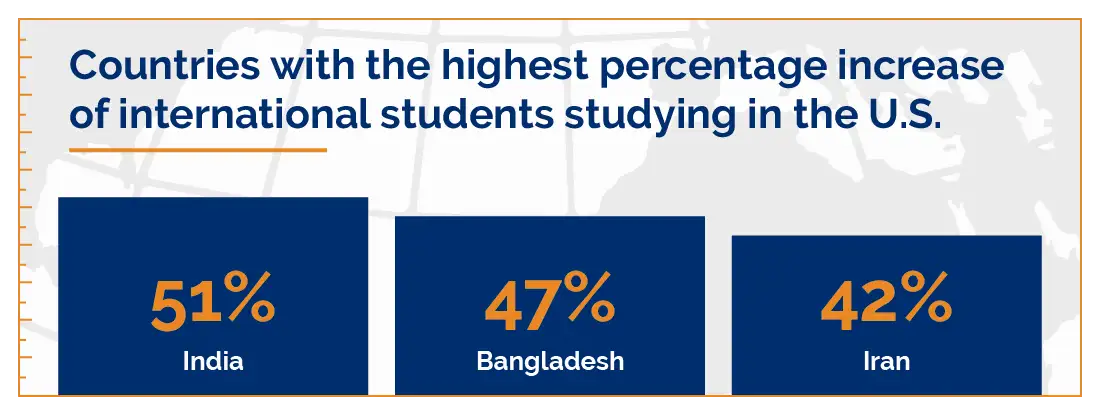
International students aren’t solely looking to U.S. universities and colleges for one particular degree. For the first time since the 2014-15 academic year, enrollment across all academic levels (graduate, undergraduate, non-degree study, and Optional Practical Training) increased. This signals that now is a prime time to build relationships with prospective institutions and students abroad to secure partnerships and enrollment at your U.S. institution.
Increased Opportunities for International Education Services
The United States remains one of the most desired countries for international students to study due to its outstanding international reputation, quality education, flexible education system, and the ease of being recruited by U.S.-based organizations.
Universities and colleges that provide programs aligning with labor market needs can provide help to international students while remaining competitive in the changing higher education landscape.
For example, many Middle Eastern countries have high unemployment rates even with a high population of young people who hold bachelor’s degrees. According to McKinsey, this is because degree holders aren’t aligning their education with job market needs. A way U.S. institutions can help improve graduate job outcomes is by offering STEM (science, technology, engineering, and mathematics) majors to support innovative industries in the region.
Additionally, India’s latest iteration of the National Education Policy (NEP), enacted in 2020, is ushering in an era of educational reform in India, focused on internationalization and fostering partnerships with foreign universities. The NEP states a lofty goal to increase its higher education enrollment population from 26.3% in 2018 to 50% by 2035 and promises a major infusion of funds for higher education and research and increasing foreign university collaboration.
How to Increase International Enrollment
India’s and the Middle East’s rising populations and demand for education present significant opportunities for international education providers.
The “Fall 2023 Snapshot” on international student enrollment received responses from over 630 U.S. higher education institutions. These were the top reasons that new international enrollment increased according to their responses:
- More active outreach to admitted students
- A more active recruitment effort by the institution
- The growing reputation and visibility of the institution abroad
- A natural rebound from the decline experienced during the COVID-19 pandemic
When you partner with international enrollment experts, such as those at Emerge Education, your higher education institution can expand visibility and recruit more international students. If one of your goals is reaching and enrolling more international students, especially in India or the Middle East, visit our international higher education page to learn more.