History of Trade Education
The history of trade education in America dates as far back as the Industrial Revolution. While the purpose of general education has been to expose students to key subjects that allow them to confidently choose a career path, vocational education provided a faster, more direct route to quickly fill the skills and labor shortages in newly booming industries. Since then, trades have largely been the answer to the workforce needs of continuous industrialization.
The Smith Hughes Act (formally the National Vocational Education Act) was one of these “trade education solutions” in response to industrialization. In 1917, congress passed the Act in response to the recommendations of the Commission on National Aid to Vocational Education. The congressionally appointed Commission urged that vocational education, “would vitalize general education and democratize schooling by adapting it to the real needs of children, promote industrial efficiency and national prosperity, decrease labor and social unrest, and promote a higher standard of living for workers.”
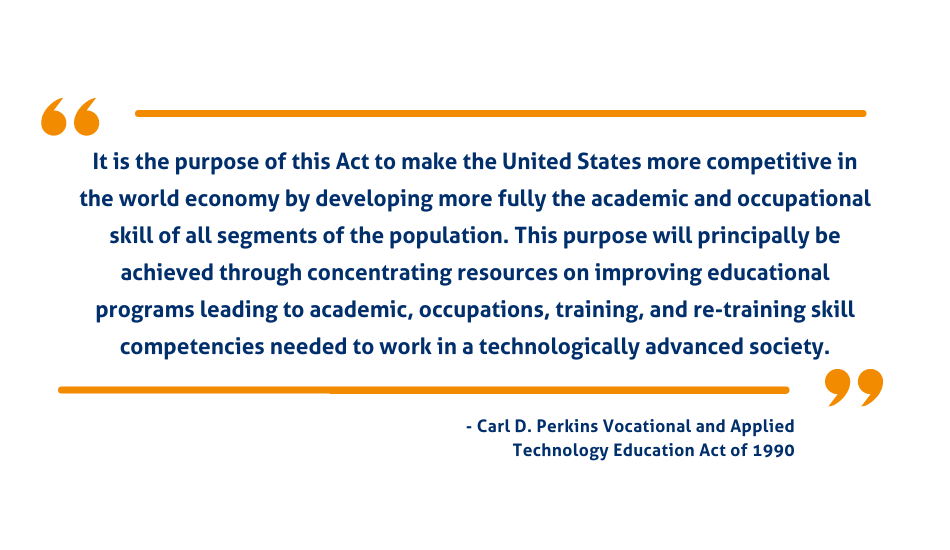
The Perkins Act, introduced in 1990, was a key moment in making vocational education more accessible in the United States, with over 10% of the $1.3 billion grant funding being allocated to Equity Programs. The program was designed to provide three main categories of funds each state can distribute amongst high schools, colleges, and universities that offer programs complementing the academic calendar year with career and technical education opportunities.
Current Trade Situation
The traditional model of education, characterized by four or more years of postsecondary level education, is no longer the exclusive route to a successful career. More and more students are turning toward vocational education as an appealing alternative. Presently, vocational education (vo-tech) is recognized as one of the fastest-growing education sectors globally. The vo-tech market is projected to grow to $1.1 trillion by 2028, largely driven by a workforce in dire need of practical skills and the flexibility that vocational courses offer.
With demand on the rise for the trade workforce, pay is also rapidly scaling for relevant positions. According to Indeed, allied healthcare professionals are at the top of the list among the highest-paying trade jobs. The promise of less student debt, higher-paying work and projected job growth are just a few of the reasons many Americans are choosing vocational education when deciding on their path to a successful career.
Popularity: The Rise of Vocational Education
One of the key factors that has caused the rise in vocational education is the accessibility of learning modes. Traditionally, vocational training has been in-person due to the hands-on nature of the skills required for the programs. However, with technological advancements, online programs accounted for nearly half of the revenue share for the vocational education industry in 2021. It is also worth noting that some of the fastest-growing job markets are those in technology, meaning the skills needed for our current workforce are shifting to more tech-savvy ones, which can be acquired via online courses.
Some students view the vocational route as a simple stepping-stone toward their career goals. An Emerge Prepared program participant at Cumberland Valley recently commented, “The Dental Assistant program is offering me a step forward toward my goal of becoming a Dentist and giving me a competitive advantage over my peers.” – Soha V., Senior at Cumberland Valley High School (Dental Assistant Program).
Programs like this are simply eliminating the anxiety students face in making tough career decisions, and even counselors are seeing that impact. “It’s our job to truly guide the students where they are going, and to show them that there are so many options and opportunities available to them. Getting them the information is extremely important in aiding their success in deciding their path.” – Lee Walton, Guidance Counselor, Cumberland Valley High School
Emerge Prepared: Meeting the Modern Learner’s Needs with Trade Programs
When it comes to navigating the pathways in this evolving vocational education landscape, Emerge Education stands out by addressing the challenges associated with traditional vocational education. Emerge Prepared programs not only emphasize practical, hands-on skills but also leverage virtual training opportunities, recognizing the modern learner’s preference for integrated, interactive and flexible learning experiences. The innovative approach that Emerge takes ensures that students can acquire valuable skills without sacrificing the social connections and familiar environments associated with traditional schools.
Through our partnerships with school districts, Emerge Prepared provides healthcare and other certificate program coursework to high school students. Complemented by the Emerge Partner Network, Emerge Prepared aids in career readiness upon graduation with highly sought-after certifications that provide an entry-point for students who are not yet seeking a four-year traditional education.
Industry Alignment and the Skills Gap
Vocational education is one clear answer to the ever-present skills gap inundating the current workforce. Because many vocational programs are developed in collaboration with industry experts, EHL Insights, “students in vocational schools spend significantly more time practicing tangible skills that they will need and can apply to the workplace.” This synergy between education and industry requirements enhances the employability of graduates, creating a direct link between vocational education and increased career success.
The evolution of vocational education signifies its ability to respond to the ever-changing demands of a shifting workforce. For leaders in some of the more popular industries and educational advisors looking to steer their students toward a successful future, it is evident that now is the time to harness the opportunities that vocational education can bring. As exemplified by Emerge’s innovative approaches to education and industry requirements, vocational education plays a crucial role in empowering students and motivated workers alike for fulfilling careers.