A changing labor market, priority shifts for job seekers, and tech advancements are making hiring harder today than before. Additionally, employees are still leaving their jobs, with 3 to 4.5 million employees quitting their jobs each month. This is why organizations must strengthen employee retention strategies. In this article, we’ll discuss how to improve retention rates through communication, career path planning, learning and development, and company culture efforts.
Why is Employee Retention Important?
An organization’s bottom line is not the only thing low employee retention affects. Others include employee morale, employee productivity, company reputation, and performance. But, improving retention rates is easier said than done.
In today’s workplace, five generations of employees (the Traditionalists, Baby Boomers, Generation-X, Millennials, and Generation-Z) bring different opinions and beliefs to work. According to McKinsey research, one factor rings true among most: usual compensation and promises of promotions are no longer enough.
The following four tips help you understand different employee motivations while boosting employee retention rates in your organization.
1. Keep Communication Open and Clear
Whether frontline workers communicate with managers or company executives communicate with the entire organization, employee satisfaction increases from open and clear communication. Forbes’ The State Of Workplace Communication In 2023 illustrates this point:
- 88% of workers say ineffective communication affects them
- Nearly half of workers say communication impacted their job satisfaction and productivity
- Over 40% of workers report decreased trust in both leadership and their team due to poor communication
Communication efforts impact in-office, hybrid, and remote workers, so one group is not more immune to ineffective communication than the other. Ultimately, the more communication there is, the better. One key communication necessity to retain employees is to discuss the organization’s available career paths.
2. Create Career Path Plans for Employees
When executives create formal career paths and ladders for their employees, they’re bound to retain top talent and further develop entry-level employees. According to SHRM, “Employees are generally more engaged when they believe that their employer is concerned about their growth and provides avenues to reach individual career goals while fulfilling the company’s mission.”
Therefore, organizations that prioritize employee development benefit from keeping younger employees, retaining overall talent, standing out against competitors who don’t offer career paths, and retaining employees during economic downturns. Employees typically reach their career path or ladder goals by putting in the work and advancing their knowledge and skills. This is why an organization must offer learning and development opportunities as well.
3. Offer Learning and Development Opportunities
Now more than ever, employees of all levels are itching to learn and further develop their skills in the workplace. Take a look at these statistics from Gallup’s report: The American Upskilling Study: Empowering Workers for the Jobs of Tomorrow:
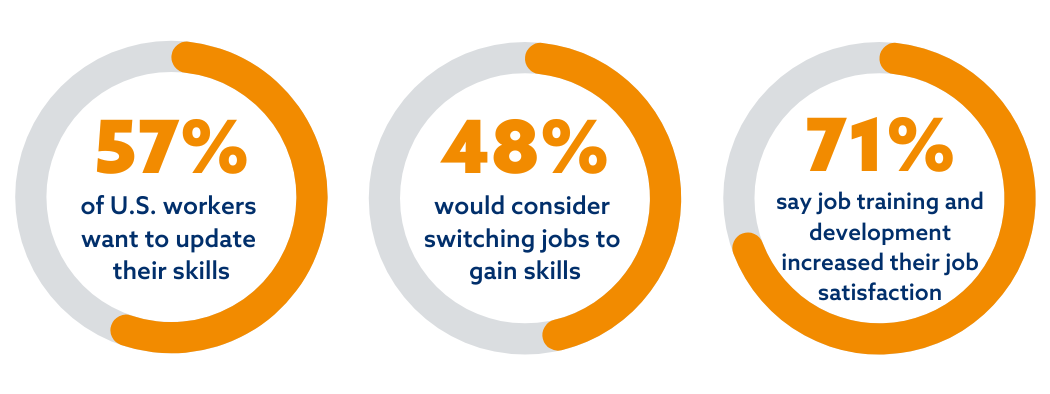
However, not just any learning and development program will fit. The first step HR and leadership should take is to assess the needs of the organization and employees. After that, you can interview employees and managers to understand the skills gap that needs to be addressed, as well as the knowledge that wants to be learned. Finally, you’ll need to evaluate an educational partner who offers exactly what your employees and organization are looking for in a workforce development program.
The more opportunities employees have to learn, the better they’ll feel about being welcomed at work. This helps boost company culture and strengthen retention rates.
4. Develop A Company Culture that Resonates With Employees
BetterUp defines company culture as “…the shared values, attitudes, behaviors, and standards that make up a work environment. It is about the experience people have at work and how that experience aligns with the external brand and messaging of the company.”
No employee wants to be part of a toxic work environment. Research shows a toxic work culture is over ten times more likely to contribute to a decrease in employee retention rates than compensation.
Toxic work cultures are unique to each organization, but they typically involve a lack of work-life balance, high levels of burnout, unrealistic expectations, discrimination, and/or lack of transparency. Developing a company culture employees are proud to be a part of should be your goal.
To develop a better company culture, leaders can show appreciation to their employees, find ways to create more flexibility, provide great compensation and benefits, and check in with employees regularly.
How Emerge Education Can Help Improve Retention Rates
When the hiring market is tough and employees across industries continue to leave their roles, it’s important to focus on the employees who work for your organization. Workforce development programs can improve company communication, career path planning, learning and development opportunities, and culture. When you team up with Emerge Education to further develop your workforce, you’re taking the next steps to improve your employee retention rates.